Reuse page structures, workflows and packages across client sites
Agency margin disappears when every project rebuilds page models, publishing controls, previews, migrations, and handover documents from scratch. The cost returns in year two when a familiar change request lands in an unfamiliar snowflake.
Recurring CMS work takes a standard Laravel shape, while the team keeps room for client-specific content, brand, components, and interaction.
More reliable estimates
Reusable house capability
A handover clients can follow
See how repeatable foundations make year-five client work easier to price, change, and hand over.
Watch on YouTubeDeliver sites you can hand over
Build repeatable pages and make future changes understandable to the client and your team.
A client website should not depend forever on the person who built its first template. Capell gives Laravel agencies a way to define page patterns, let editors make useful changes and keep recovery visible. The commercial value comes from a clearer build and handover, not an unsupported promise of faster delivery on every project.
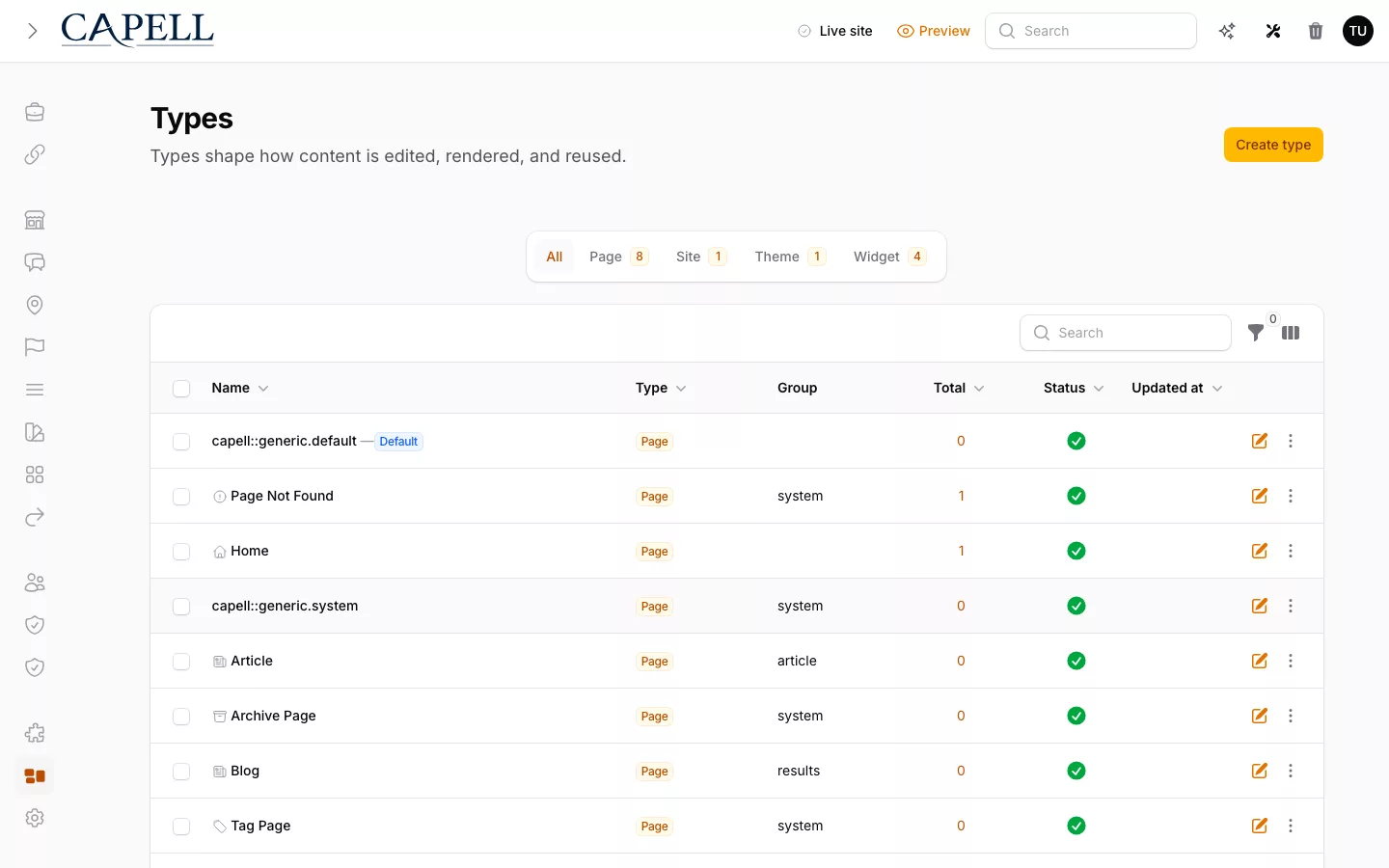
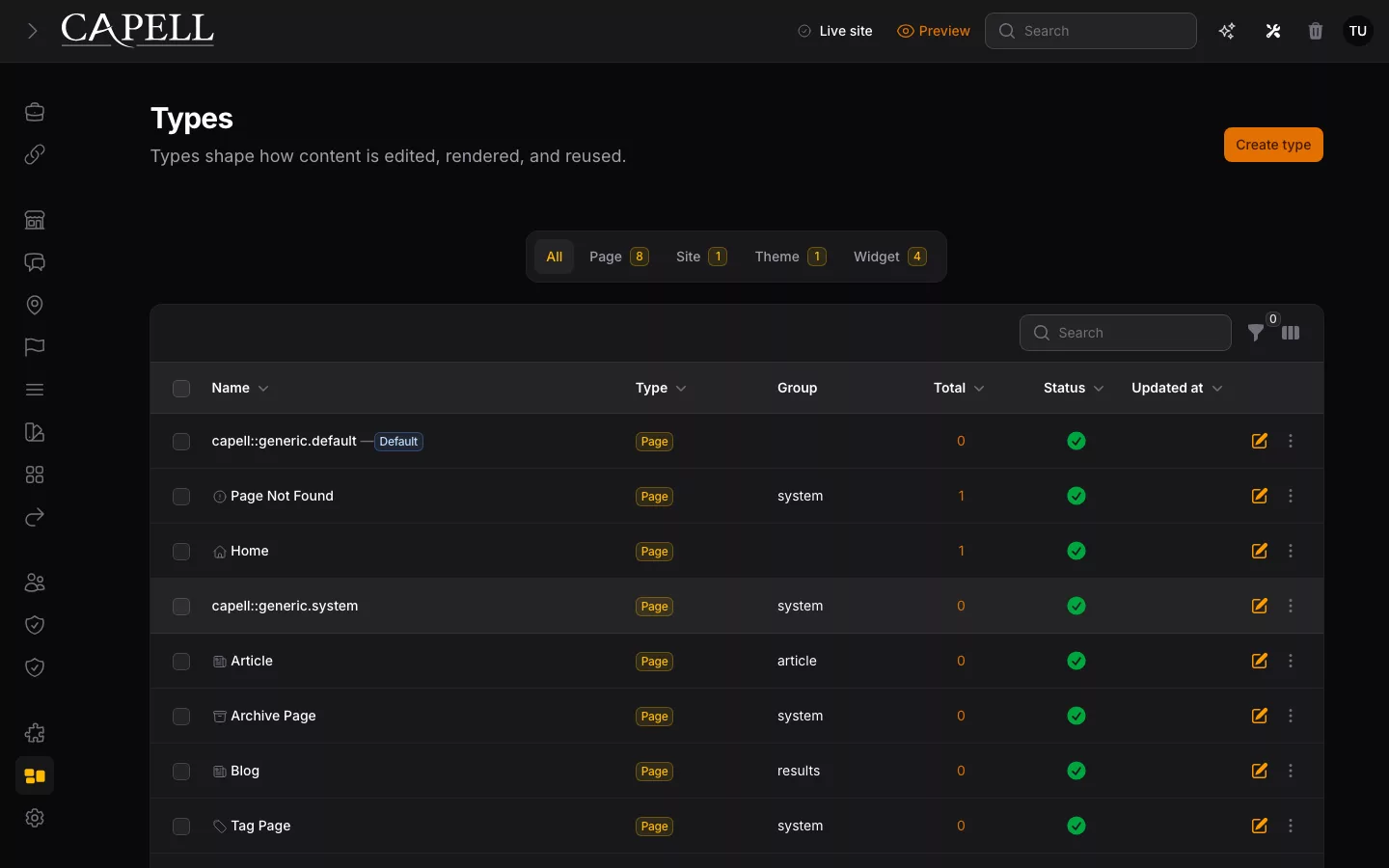
Qualify before you quote
Find the repeated pages and the workflow that drive the estimate.
Ask the client who edits, who approves and which changes currently wait for a developer. Identify the page families and application integrations before selecting packages. Reuse approved implementation patterns where they fit, without treating every client's content and permissions as identical.
Include maintenance and licence requirements in the proposal. Check the current terms rather than inventing an agency entitlement from a package example. A representative pilot can expose the difficult part before it becomes a fixed-price surprise.
Hand over the change process
Make the next update and the first mistake part of acceptance.
Show the client how to find a page, preview it and inspect its history. Agree what they can publish and what remains application work. Keep a clear route for urgent content corrections without bundling them into unrelated deployments.
Document package usage, upgrade ownership and recovery responsibilities. The project remains a Laravel application that someone must operate. A good handover makes that work visible rather than hiding it behind an administration login.
Reuse the work clients keep paying for
The strongest reuse is often invisible to the final design: known page patterns, editor rules, install checks, package boundaries, migration inventories, and handover evidence. Review why Capell standardises those boundaries.
Build repeatable client sites
Reuse familiar Laravel and Filament skills, house packages, launch checks, and handover practices. Keep the client's visual identity, requirements, and application code specific to the brief.
Reusable page structure
- Outcome
- Deliver a repeatable CMS structure while leaving each client with a portable Laravel application.
- Source
- Foundation
- Maturity
- Released
Page history and recovery
- Outcome
- Hand over a site with standard page recovery already included.
- Source
- Foundation
- Maturity
- Released
Team publishing workflow
- Outcome
- Hand clients a repeatable approval and release workflow.
- Source
- Optional package
- Maturity
- Released
Referral reporting
- Outcome
- Give site owners a clear view of referral sources without introducing a visitor-tracking service.
- Source
- Optional package
- Maturity
- Beta
AI and agent delivery
- Outcome
- Track safe discovery, validation, preview, and controlled agent-assisted delivery.
- Source
- Roadmap
- Maturity
- Labs
Automation and integrations
- Outcome
- Track repeatable integration capability without hiding project-specific delivery work.
- Source
- Roadmap
- Maturity
- Labs
Experimentation and growth
- Outcome
- Track reusable growth capability while keeping strategy and integration in scope.
- Source
- Roadmap
- Maturity
- Labs
Trust, compliance, and operations
- Outcome
- Track handoff-friendly operational controls for maintained client applications.
- Source
- Roadmap
- Maturity
- Labs
Customer self-service
- Outcome
- Track portable client-owned portal capability for suitable Laravel projects.
- Source
- Roadmap
- Maturity
- Labs
Delivery questions
Questions that protect the estimate and handover
How much can we reuse without repeating the last design?
Reuse page models, editor rules, house packages, checks, and delivery practices. Keep the client's brand, content decisions, components, and custom application work specific to the brief.
Compare theme starting points
Where does repeatability improve agency margin?
It reduces discovery and implementation uncertainty around recurring CMS work, then lowers the archaeology cost when familiar changes arrive after launch.
Apply the year-five test
What should a clean handover contain?
The client organisation should own production, source, data, billing, and Capell entitlements. Agency access should use named users. Handover should include the page and publishing model, package and licence inventory, deployment and recovery checks, support boundaries, and a verified removal of agency-only access.
Review current engineering results
When should we deliver something simpler?
Use a lighter local tool or a simple custom setup for a small, one-off site with few editable pages and little expected change. Capell pays off when repeat delivery and year-two ownership matter.
Check the fit guide
Agency CMS work repeats even when the design does not. Teams model articles and case studies again, reconnect previews and URLs, rebuild editor controls, copy integration code, and write another handover from a blank page. The fifth bespoke setup often costs more to estimate and support than it did to win.
Recurring delivery work can take a standard Laravel shape. Page types, editor workflows, themes, house packages, install checks, and upgrade guidance become familiar across projects. The client's brand, content decisions, components, and application-specific work remain open to the brief.
Where repeatability pays off
- Estimates spend less time rediscovering recurring CMS plumbing.
- House functionality travels as reviewed packages instead of copied code.
- Editors receive clear page shapes and fewer reasons to join the support queue.
- Handover includes source, accounts, publishing responsibilities, package details, and checks the client can keep.
Client-owned handover contract
- The client organisation owns production hosting, source, data, billing, domains, and Capell entitlements.
- Agency team members use named access; shared credentials are not a handover mechanism.
- The package and licence inventory names versions, owners, renewal dates, support routes, retained data, and removal effects.
- Deployment, backup, recovery, upgrade, and representative editor workflows are rehearsed with the receiving owner.
- Transfer is complete only after the client verifies access and agency-only access is removed or explicitly retained.
Capell does not currently certify agencies or publish an agency directory. Those programmes require a real pilot, current evidence, and explicit participant consent.
This is an honest commercial fit decision. A small, one-off brochure site with few editable pages may be faster and cheaper with a simpler tool. Capell is for client work where repeat delivery, maintainable ownership, and a clean year-two relationship justify the extra structure.
Qualify, quote, hand over
Qualify
Reuse page models, editor rules, house packages, checks, and delivery practices. Keep the client's brand, content decisions, components, and custom application work specific to the brief.
Quote
Each client organisation needs its own Publishing Studio term. Five terms cost £295 for year 1.
Hand over
The client organisation should own production, source, data, billing, and Capell entitlements. Agency access should use named users. Handover should include the page and publishing model, package and licence inventory, deployment and recovery checks, support boundaries, and a verified removal of agency-only access.
Prepare for maintenance after handover
Repeatable delivery pays off again after launch. The team can recognise where a request belongs, inspect the same kinds of evidence, and improve shared work without pretending every client has the same site.
Role scenarios
What to inspect in repeatable delivery
Prompts for testing repeatable delivery, client boundaries, handover, and support cost.
Role-based checks drawn from product capabilities and fit boundaries.
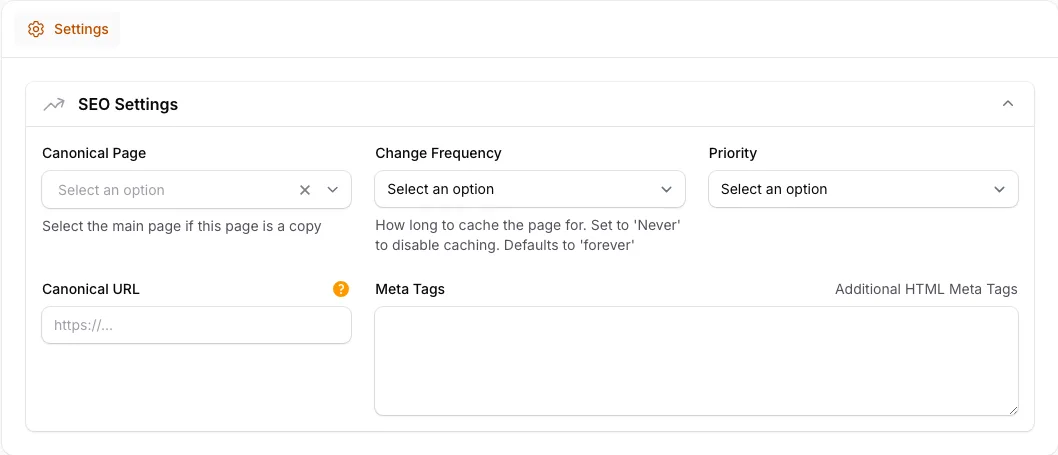
Measure reuse across two client builds
Build two client sites from the same page types and layouts, then apply a shared structural change. Scope should stay contained per client while the reusable change avoids a second bespoke implementation.
Read more Show less
Check that the extension audit rejects an incompatible package and that the release can be rolled back. After handover, ask the editor to make and publish a content change without developer help.
Alternative fit: The shared model is a constraint. A client who wants a wildly bespoke one-off with no relation to anything else teams run will fight that structure, and for them a from-scratch build is the honest call.

Delivery economics a developer feels too — what to verify
Apply one shared page-type improvement across two client builds and run the extension audit in CI. Both sites should inherit the change, and an unsafe package must fail before handover.
Read more Show less
Inspect this behaviour: capell:extension-audit runs in CI and fails the build when an add-on would poison shared cache state or declares an incompatible API version. Exercise both failures before handover and require a clean audit for the client build.
A different tool may fit when: Work that shares nothing between projects is still better bespoke, because there is no reuse to bank. This pays off across a book of similar builds, not on a genuine one-off.

Consistency that survives handover — what to verify
Open two client sites built on the shared content structure and perform the same publishing action. Fields, layouts and state changes should remain predictable even when another studio built the site.
Read more Show less
The demonstration should show: Because the fields and layouts follow a known pattern, their day-to-day work is not hostage to whoever happened to construct it. Picking up a site someone else built is learning a familiar shape, not reverse-engineering a stranger's private construction.
Scope check: When the content genuinely breaks every pattern, a custom build can still be the right call. Shared structure helps when the site fits a recognisable shape, not when it is deliberately unique.