
Capell home
Live demo

Manage cookie preferences

Choose which optional cookies Capell may use.

Essential
Always on

Required for Capell to work — login, security, page rendering.

Analytics

Anonymous usage telemetry to improve editor performance.

Marketing

Personalization for the Capell marketing site.

Cookie policy

Run the website by intent, not by menu hunting

Capell is a Laravel CMS built on Filament. Its AI Command Centre turns plain-language requests into typed, permission-aware capabilities: find a site by domain, open a page by title, create a draft, clone content you own, schedule a release, inspect an extension, or prepare an original site plan.

Human-readable targets Exact previews One-use confirmation
CMS capture: agent context AI context is assembled inside an explicit boundary. The real Agent Bridge screen shows where trusted package context is selected and prepared before an external agent receives it.
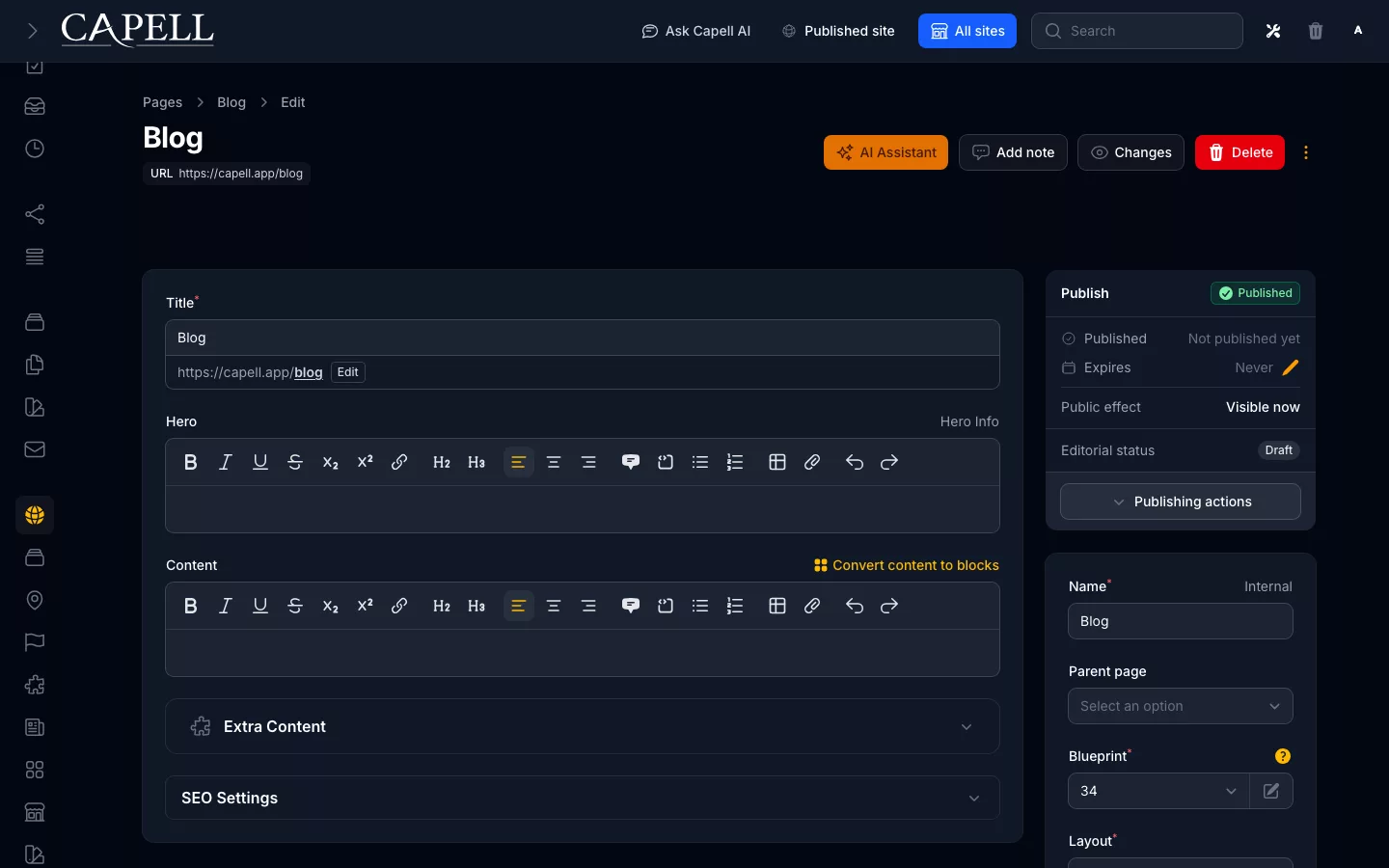
CMS capture · Content index Structured content stays visible in the admin. The screenshot comes from the Capell CMS admin, where page records, preview images, layouts, SEO status, and editor actions stay visible without opening every page.
Recorded workflow: review Move the draft through review. Frame two keeps the approval state, reviewer context, and next action visible in the actual CMS interface.

Actual Agent Bridge prompt builder screen showing scoped package context and prompt controls inside Capell.

Capell's AI Command Centre lets editors and administrators describe outcomes in ordinary language. The shared capability catalogue resolves human-readable site, page, and package references, validates authority, presents an exact preview, and requires confirmation where the operation can change data or release state.

Optional AI Creator adds provider-backed, queued site generation. It constrains output to the live site schema and installed Capell choices, records the run, keeps previews private, and refuses external scraping or close reproduction. Applying the validated plan uses the same one-use Agent Bridge confirmation path as other high-risk work.

What to verify

  • Autocomplete shows only capabilities the installation contributes.
  • Page and site records can be found by names, domains, slugs, and URLs without exposing internal identifiers.
  • Package activation is limited to registered code already present through Composer.
  • Preview is non-mutating and the matching confirmation can be used only once.
  • Public output contains approved content, never agent prompts, permissions, audit state, editor URLs, or model metadata.
Interactive command flow

See the safety model while the command is still reversible

The same capability catalogue powers typed prompts, voice input, autocomplete, external agents, and package-contributed tools. Names, titles, slugs, domains, and URLs stay human-facing; internal identifiers remain inside Capell.

This is a public demonstration of the workflow. It is not connected to an admin account and cannot change a site.

AI Command Centre
Demonstration only

Autocomplete uses capabilities installed on the site.

Resolved operation

capell.pages.open_editor

Open an existing page

Target found by
Page title or URL
Authority
Current editor policy
Risk
Read
  1. Understand intent
  2. Resolve target
  3. Check authority
  4. Preview impact
  5. Confirm
  6. Audit
Exact preview

Open About in the page editor

No confirmation

Capell resolves one accessible page from its title and returns the admin destination only to the signed-in editor.

What would change
  • No content change
  • No public response change

Public output never receives the editor URL, record identifier, permissions, or field paths.

No operation runs from this public demonstration.

Governed site generation

AI Creator turns a brief into a private, reviewable site

Brief

Describe the organisation, purpose, audience, tone, required pages, and any abstract inspiration.

Generate

A queued provider call proposes original copy and structure using only installed Capell choices.

Validate

The site, theme, pages, sections, language, private visibility, and content rules must pass the live schema.

Review and apply

Inspect the private preview and exact impact, then confirm once or send the brief back for another draft.

Architecture

A capability system, not a chatbot with admin access

Start from the task. Capell discovers installed capabilities with their names, descriptions, intents, examples, schemas, risks, and confirmation requirements. The command interpreter can suggest a match, but the capability still resolves records and enforces policy for itself.

  1. Model

    Intent

    Typed, spoken, or agent-supplied language describes the outcome without exposing internal record identifiers.

    See why it matters

    Typed, spoken, or agent-supplied language describes the outcome without exposing internal record identifiers.

    See the capability boundary
  2. Model

    Resolver

    Sites, pages, and packages are matched from names, domains, titles, slugs, URLs, and registered package keys.

    See why it matters

    Sites, pages, and packages are matched from names, domains, titles, slugs, URLs, and registered package keys.

    See the capability boundary
  3. Model

    Capability

    A typed Action owns validation, preview, execution, output schema, risk, and audit event for one operation.

    See why it matters

    A typed Action owns validation, preview, execution, output schema, risk, and audit event for one operation.

    See the capability boundary
  4. Model

    Policy

    The current user, token scopes, package state, site access, and native publishing readiness are checked at execution time.

    See why it matters

    The current user, token scopes, package state, site access, and native publishing readiness are checked at execution time.

    See the capability boundary
  5. Model

    Confirmation

    Mutations bind an opaque, expiring, one-use token to the user, payload, capability, and reviewed preview. Persistent confirmation secrets are stored only as keyed hashes.

    See why it matters

    Mutations bind an opaque, expiring, one-use token to the user, payload, capability, and reviewed preview. Persistent confirmation secrets are stored only as keyed hashes.

    See the capability boundary
  6. Model

    Audit

    Secret-scrubbed entries record previews, confirmations, rejections, and results without leaking them into the public site.

    See why it matters

    Secret-scrubbed entries record previews, confirmations, rejections, and results without leaking them into the public site.

    See the capability boundary

Useful autonomy stops at an explicit boundary

Autocomplete is generated from installed, discoverable capabilities. Voice is only another input method. Preview remains non-mutating, confirmation expires after one use, policies are checked again at execution, and public HTML receives only approved render data.

Review the trust model
Targeting

Names and URLs, not exposed IDs

Suggestions

Installed capabilities only

Preview

Non-mutating by contract

Confirmation

Opaque, expiring, one use

Extensions

Composer-present packages only

Cloning

Owned internal content only

Generated sites

Original and private by default

Public output

No admin or agent metadata

Next step

Give your team a faster way to ask, without weakening the way Capell acts

Start with record lookup and previews. Add publishing, extensions, and AI Creator as each policy and workflow is ready.

The useful first test is simple: name a real page, ask Capell to open or change it, and inspect the resolved target and exact preview. Then trace the same operation through an external agent.

Loading footer